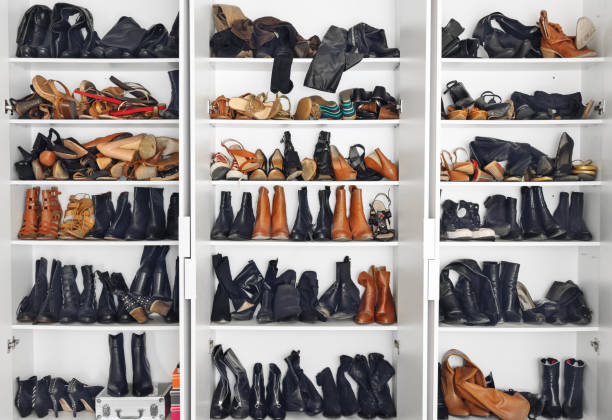
When your closet barely fits your clothes, finding room for shoes feels like a losing battle. Pairs end up stacked on the floor, shoved under the bed, or jammed into a pile by the front door where you trip over them every morning. If you have a small closet and more shoes than you would like to admit, the issue is almost never that you have too many pairs. It is that you are not using your space efficiently.
These storage ideas work in tight closets, small apartments, and shared spaces where every square inch matters.
No major renovations required.
Over-the-Door Shoe Organizers
The simplest upgrade you can make is hanging an over-the-door organizer on the inside of your closet door. These clear-pocket organizers typically hold 12 to 24 pairs of shoes depending on the size, and they use space that is otherwise completely wasted. The see-through pockets let you spot the pair you want without digging through anything.
For heavier shoes like boots or sneakers, look for organizers with reinforced stitching and a sturdy metal hook.
The cheaper vinyl versions sag quickly once you load them up. Canvas or heavy-duty fabric organizers hold up much better over time. Mount the hook over a hollow-core door carefully, as the combined weight of 20 shoes can stress a lightweight door.
This solution is especially good for renters because it requires zero permanent installation. When you move, the organizer comes off in seconds.
Stackable Shoe Boxes
Clear stackable shoe boxes are one of the most popular closet organization tools right now, and they deserve the hype.
Each box holds a single pair, keeps them dust-free, and stacks vertically to use height instead of floor space. You can build a tower of shoe boxes against a closet wall and see every pair at a glance through the clear sides.
The drop-front style boxes are worth the small price premium over standard lidded boxes. Instead of unstacking the entire tower to reach a pair in the middle, you pull down the front panel of whatever box you need.
It makes a huge difference in daily use when you are getting ready in a hurry.
Standard size boxes work for most sneakers and flats. If you collect boots or high-tops, measure the height of your tallest pair before ordering because some boxes are too short for anything above ankle height.
Tension Rods for Heels
If you own several pairs of heels, a tension rod across the lower section of your closet can hold them neatly without taking up floor space. Install the rod at whatever height makes sense for your heels, then hang each pair by hooking the heel over the rod.
The shoes hang vertically, and you can fit a surprising number of pairs across a single rod.
This trick works best with stilettos and pumps that have a defined heel stem. Wedges and platform shoes do not hang as well because the heel is too thick to hook over a standard tension rod. You can install multiple rods at staggered heights to maximize the vertical space in a closet that has a tall lower section.
Under-Bed Rolling Storage
The space under your bed is prime storage real estate that most people waste.
Low-profile rolling storage bins designed for shoes slide under the bed and keep seasonal pairs out of sight but accessible. This is a great solution for shoes you only wear part of the year. Summer sandals go under the bed in winter, boots go under in summer.
Look for bins with a zippered lid to keep dust out. Wheels are a must because pulling a flat bin loaded with shoes across carpet is a pain.
Measure the clearance under your bed before buying. Most under-bed bins are about five inches tall, but bed frames vary a lot. If your bed is low to the ground, you may need to add bed risers to create enough clearance.
Wall-Mounted Shoe Racks
When floor space is the main constraint, go vertical. Wall-mounted shoe racks attach directly to the closet wall or the back of a closet door and hold shoes on angled shelves or horizontal bars.
Because they do not touch the floor, you free up the closet floor for larger items like luggage or storage bins.
Floating shelves are another option if you want something that doubles as decor. Install a row of narrow floating shelves along one wall and display your favorite pairs. This works particularly well in entryways or bedrooms where the closet is too small to hold everything. The visual effect is clean and intentional rather than cluttered.
If you are renting and cannot drill into walls, look for adhesive-mounted hooks or rails rated for the weight you plan to hang.
Command strip-style hooks can hold lighter shoes like sandals and flats, but heavier boots and sneakers need screw-mounted hardware.
Shoe Turntable (Lazy Susan)
A spinning shoe turntable fits into a closet corner and lets you rotate through your collection without reaching to the back. These turntables usually hold 12 to 18 pairs arranged in a circular pattern across two or three tiers.
You spin the platform to find what you need, which eliminates the problem of pairs getting buried in the back corner of the closet.
This option works best if you have a closet with a deep corner that is hard to access otherwise. The footprint is compact, roughly the size of a large pizza, and the vertical tiers make good use of height. Just check the weight capacity before loading it up, because some cheaper turntables wobble under heavy shoes.
The One-In-One-Out Rule
No amount of clever storage will help if you keep adding shoes without removing any.
The simplest way to keep a small closet manageable is the one-in-one-out rule. Every time you buy a new pair, one pair you no longer wear gets donated, sold, or tossed. It forces you to think about whether a new purchase is actually worth the space it will take up.
If you have not worn a pair in over a year, it is probably safe to let it go. Shoes that are damaged, uncomfortable, or completely out of style are taking up room that could hold something you actually use.
A seasonal audit, once in the spring and once in the fall, keeps your collection honest and your closet functional.
Putting It All Together
The best storage system for a small closet usually combines two or three of these ideas. An over-the-door organizer for everyday shoes you grab regularly, stackable boxes for nicer pairs you want to keep clean, and under-bed bins for seasonal shoes you do not need daily. That combination covers most shoe collections without eating into your closet clothing storage.
Start by counting how many pairs you actually need to store, then measure your available space. Knowing those two numbers makes it much easier to pick the right combination of solutions instead of buying organizers that turn out to be the wrong size or hold too few pairs.